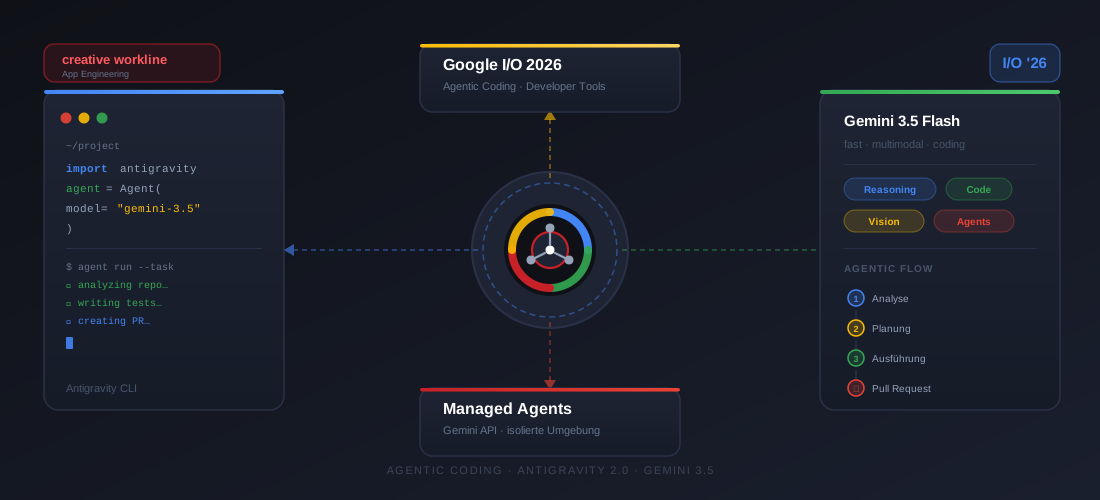
Google I/O 2026 made it clear: AI coding is moving from autocomplete and IDE chat toward autonomous development agents. While many development teams have mainly experimented with GitHub Copilot, Cursor, Claude Code, or OpenAI Codex, Google is now positioning itself much more broadly with Gemini 3.5 Flash, Google AI Studio, Antigravity 2.0, Managed Agents, and new Android integrations.
The goal is visible: Google does not only want to provide models, but complete development environments for agentic software development. The decisive question is therefore no longer whether AI helps with programming. The question is: how do teams organize context, architecture, quality, and responsibility when several agents work in parallel on production-adjacent codebases?
Definition: what does agentic coding mean?
Agentic coding describes development work in which AI systems do not only produce individual code suggestions, but independently plan and execute tasks across multiple steps. This includes repository analysis, terminal commands, test runs, browser automation, Git operations, pull requests, and iterative corrections.
The developer becomes less of a pure code typist and more of an architect, orchestrator, and reviewer. That is a different mode of work than classic IDE autocomplete.
From autocomplete to autonomous development agents
Many teams still associate AI coding with better suggestions while typing, code explanations, boilerplate generation, or chat windows inside the IDE. These features remain useful, but they are no longer the main trend.
Modern systems increasingly work like autonomous developer agents:
- They analyze entire repositories.
- They run terminal commands and tests.
- They work with Git and branches.
- They change several files consistently.
- They coordinate subtasks through subagents.
- They use browsers, tools, and local project rules.
- They iterate after errors, test output, or review comments.
Claude Code and OpenAI Codex have strongly shaped this shift in professional day-to-day work: away from a single prompt and toward agents that understand repositories, change files, execute commands, and make results verifiable. This is exactly the area Google is now attacking with Antigravity 2.0, AI Studio, and the new Gemini models.
The new Google AI landscape after I/O 2026
For a long time, Google had a confusing product portfolio around AI and development. With I/O 2026, the structure is clearer, even if it is still very much in motion.
| Product | Role |
|---|---|
| Gemini | Models for reasoning, coding, multimodality, and agents |
| Google AI Studio | Browser-based prototyping, vibe coding, and fast app experiments |
| Antigravity 2.0 | Agent-first development platform with desktop app, CLI, and SDK |
| Managed Agents in the Gemini API | Hosted agents with an isolated environment through an API |
| Vertex AI and Gemini Enterprise | Enterprise platforms for operation, governance, and integration |
| Gemini Code Assist and Android Studio | Classic IDE assistance and Android-specific agent capabilities |
One especially relevant detail is that Firebase Studio is being sunset on March 22, 2027, and projects are expected to move toward Google AI Studio or Antigravity. This shows that Google is bundling its AI developer tools more strongly around AI Studio, Antigravity, and Gemini.
AI Studio: Google's answer to vibe coding
Google AI Studio is positioned clearly in the space of "from idea to running app." The focus is on fast prototypes, Firebase integration, multimodal inputs, UI generation, Workspace integrations, and full-stack prototyping directly in the browser.
A typical workflow:
Prompt
-> generated app
-> test
-> iterate
-> deploy or export to Antigravity
For MVPs, internal tools, demos, and fast experiments, that is attractive. Google is also extending AI Studio with native Android support, so Kotlin-based Android apps can be generated by prompt.
Where AI Studio reaches its limits
As soon as projects become larger and longer-lived, typical problems appear:
- Architecture drifts.
- Codebases become inconsistent.
- Dependencies become harder to control.
- Team workflows remain limited.
- Tests, releases, and reviews need more structure.
- Local repository contexts are not integrated as deeply as in agent-first development environments.
This is reminiscent of earlier no-code and low-code waves: prototypes gain speed, but production-critical systems still need architecture, ownership, and quality assurance. For serious Android, iOS, or Kotlin Multiplatform projects, AI Studio will therefore be more of an entry point than the only development environment.
Antigravity 2.0: Google's real attack
More interesting for professional teams is Antigravity 2.0. Google describes Antigravity as an agent-first development platform. That gets to the heart of it: Antigravity is not just an IDE with AI, but an interface for steering autonomous development agents.
Antigravity 2.0 is intended to:
- analyze local repositories
- run terminal commands and tests
- use Git workflows
- integrate browser automation
- coordinate several agents in parallel
- handle recurring tasks in the background
- make agents available through CLI and SDK
- take over Firebase, Android, and AI Studio context
That positions Google directly against Claude Code, OpenAI Codex, and Cursor. The difference from AI Studio is especially important: Antigravity is not primarily aimed at fast throwaway prototypes, but at real development work in existing or production-adjacent projects.
AI Studio and Antigravity compared
| Criterion | Google AI Studio | Antigravity 2.0 |
|---|---|---|
| Goal | Fast prototypes | Production-adjacent development |
| Surface | Browser | Desktop app, CLI, and SDK |
| Focus | Vibe coding | Agent-first engineering |
| Comparable with | Lovable, Bolt, v0, Replit AI | Claude Code, OpenAI Codex, Cursor |
| Repository access | More project- and export-oriented | Deeply integrated into development workflows |
| Terminal and Git | Limited | Central |
| Multi-agent workflows | Limited | Core capability |
| Architecture work | Medium | Stronger |
| Team workflows | Restricted | Designed more professionally |
The obvious split is: AI Studio for exploration, Antigravity for implementation and ongoing development.
Gemini 3.5 Flash: why fast models are becoming more important
One of the most interesting developments is not the surface, but the model behind it. According to the Google DeepMind model card, Gemini 3.5 Flash is a multimodal reasoning model focused on quality, cost, and latency. Google explicitly positions it for agentic workflows and coding tasks.
That fits a larger trend. In the past, people often assumed: larger model equals better. For agentic systems, other qualities become more important:
- speed
- cost control
- parallelization
- tool use
- long contexts
- many short iterations
Modern agent systems do not send a single huge prompt. They work with many small requests, several subagents, test runs, file analyses, and correction loops. That makes fast models like Gemini Flash attractive.
A robust architecture could look like this in the future:
Large model
-> architecture, prioritization, difficult decisions

Fast models
-> implementation, research, tests, subtasks, routine changes
That resembles human teams: senior engineers make architecture decisions, while several specialized developers implement parallel work packages.
Claude Code and Codex still feel more mature right now
Despite Google's strong announcements, Claude Code and OpenAI Codex currently often still feel more mature in professional day-to-day work than Google's new overall package. Especially for large refactorings, architecture decisions, Kotlin and Compose projects, multi-file changes, and repository-aware work, these tools are very relevant comparison points for many development teams. Codex clearly belongs in the same category as Claude Code and Antigravity. It is a coding agent for local development environments, IDE integration, cloud tasks, and parallel agent workflows, not only autocomplete or a chat window.
Google has other advantages: integration with Android, Firebase, Cloud, Workspace, the Gemini API, and enterprise platforms. If these parts work together cleanly, the result is a very powerful ecosystem. The risk lies in Google's typical product fragmentation: many strong building blocks are only helpful if they form a consistent workflow for teams.
What does this mean for Android and KMP teams?
For Android and Kotlin Multiplatform teams, this development is especially relevant. Modern mobile development has many characteristics that fit agentic workflows well:
- large modular codebases
- repetitive UI work
- architecture rules
- build and dependency complexity
- tests and emulator workflows
- API integrations
- state management
- design systems
- store and release processes
Especially with Kotlin, Jetpack Compose, Compose Multiplatform, and KMP, pure code volume does not determine quality. What matters is whether the agent understands architecture boundaries, state flows, platform differences, build logic, and test strategy.
For teams, the core question therefore shifts from "Who writes the code?" to "How do we organize context, architecture, and quality?"
AGENTS.md is becoming more important than many people think
One practical trend matters independently of the tool: central AI rule files. Depending on the tool, they are called for example:
AGENTS.mdCLAUDE.mdDESIGN.mdARCHITECTURE.md
They contain architecture rules, naming conventions, UI guidelines, allowed dependencies, testing requirements, security rules, and project structures. These files are becoming the working memory of modern development teams.
Especially in Compose, Kotlin Multiplatform, and large Android projects, this can have a major impact on quality and consistency. An agent only works as well as the context it receives and the team reviews.
Alongside IDEs and coding agents, another layer is emerging: agent orchestration. Tools such as Paperclip organize several agents through goals, roles, budgets, tickets, and approvals. Google is moving in a similar direction with Antigravity 2.0, Managed Agents, and the Antigravity SDK, although more strongly from the developer platform side.
The real danger: AI accelerates chaos
AI does not automatically improve bad processes. Without clear architecture, good reviews, clean contexts, small tasks, and clear responsibilities, the result is often just chaos produced faster.
The most productive teams will likely be the ones that combine strong architecture with good agent steering:
- small vertical tasks instead of huge prompts
- explicit project rules instead of implicit knowledge
- tests and build checks as the standard
- human reviews for domain and architecture decisions
- clear boundaries for dependencies, security, and privacy
- traceable Git workflows instead of uncontrolled mass changes
Agentic coding is not a replacement for engineering discipline. It amplifies that discipline, or exposes its weaknesses faster.
Sources and assessment
The most important announcements come from official Google and Firebase sources:
- Google I/O 2026 Developer Keynote Recap
- Developer highlights from Google I/O 2026
- Google AI Studio at I/O 2026
- Gemini 3.5 Flash Model Card
- Firebase Studio sunset and AI Studio integration
- OpenAI Codex product page
- OpenAI Help Center: Codex in ChatGPT
The assessment of Claude Code, Codex, and Cursor is a practical judgment. It depends heavily on the project, model version, repository quality, team rules, and concrete workflow.
FAQ
Does Antigravity 2.0 replace classic IDEs?
Not completely. Antigravity shifts the focus from manual IDE work to agent steering. For many teams, it will sit alongside existing tools or take over specific tasks: analysis, refactoring, test runs, prototyping, Git changes, and background work.
Is Google AI Studio suitable for production apps?
For prototypes, internal tools, and early MVPs, AI Studio can be very useful. Long-lived production apps still need architecture decisions, code reviews, tests, privacy review, dependency control, and clear ownership.
Why is Gemini 3.5 Flash interesting for agentic coding?
Agentic workflows need many fast, inexpensive, parallel model calls. A Flash model with good tool use and reasoning ability can therefore be more valuable inside agent systems than a slow large model for every single subtask.
What should Android teams do now?
Android teams should not blindly switch to a new tool. A controlled start is more useful: document project rules, define small agent tasks, automate build and test commands, sharpen review processes, and then deliberately compare tools such as Claude Code, OpenAI Codex, Cursor, AI Studio, or Antigravity.
Bottom line
Google I/O 2026 sent a clear signal: agentic coding is no longer a toy. AI Studio shows how quickly modern prototypes can be created. Antigravity 2.0 is Google's clearest challenge yet to Claude Code, OpenAI Codex, and Cursor.
Even so, Google's ecosystem still feels experimental and fragmented in places. Claude Code and Codex currently often feel more directly oriented toward real engineering work in professional day-to-day use. But Google is investing heavily and has a strong foundation with Android, Firebase, Cloud, Workspace, and Gemini.
For development teams, the decisive skill of the next few years will no longer be typing code as quickly as possible. What matters more is orchestrating people, agents, and architecture in a meaningful way.